As you pick up a pencil and start to draw, do you struggle to capture the subtleties of light and shadow on your subject? Creating realistic drawings can seem like a daunting task, especially for beginners. But with practice and the right techniques, you can develop your skills and observation abilities to create more lifelike artwork. To get started, it’s essential to understand the fundamental tools and techniques involved in realistic drawing, such as choosing the right materials, mastering various line weights and textures, and developing your ability to observe and render details accurately. In this beginner-friendly guide, we’ll cover these essential topics and provide you with practical tips and advice on how to improve your skills, ultimately enabling you to create more realistic drawings that showcase your artistic potential by the time you finish reading this article.
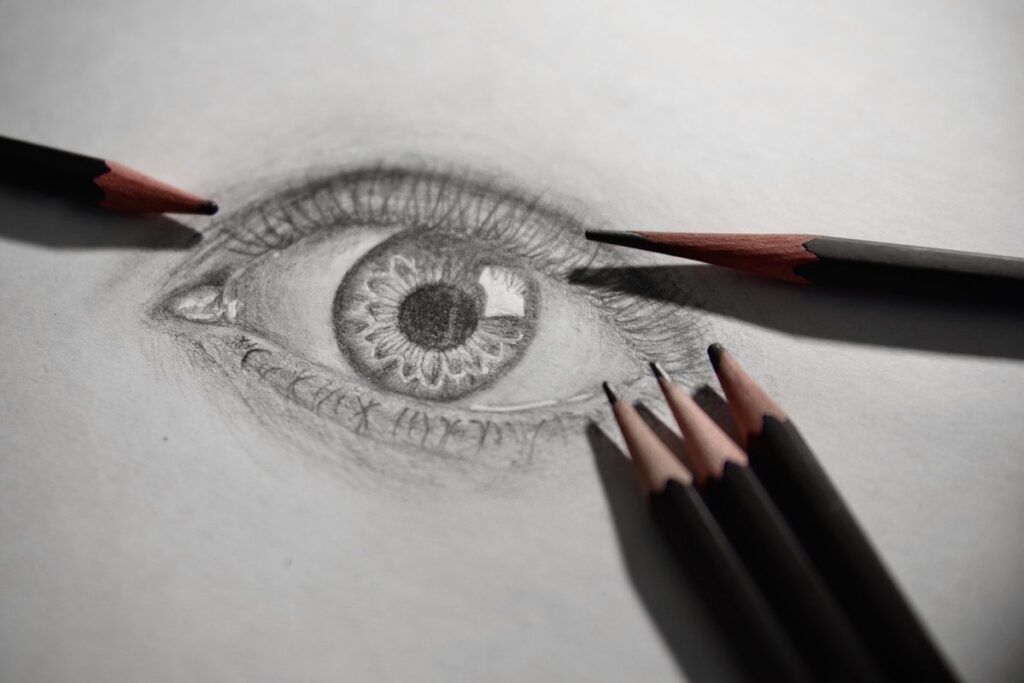
Understanding Realism in Drawing
Now that you have a basic understanding of drawing fundamentals, let’s focus on what makes a realistic drawing truly convincing: accurately representing the world around us. This requires a solid grasp of realism principles.
What is Realism in Art?
When creating realistic drawings, it’s essential to understand what realism means in art. Realism refers to the accurate and detailed representation of subjects, often using natural light and color. This doesn’t mean copying reality exactly; rather, it involves observing and rendering the subtleties that make a subject look real.
To achieve realism, artists use various techniques, such as studying the play of light on surfaces and capturing the nuances of color and texture. Natural light is particularly effective for creating realistic drawings, as it can be used to create soft shadows and subtle highlights. Beginners should experiment with different lighting setups to get a feel for how light affects their subjects.
Understanding realism also means being mindful of proportion, anatomy, and detail. Artists who aim for realism often spend time studying the underlying structure of their subject matter, from the way muscles are arranged in a figure to the pattern of veins on a leaf. By paying attention to these details, you can create drawings that look convincingly real.
Benefits of Realistic Drawings
When you focus on creating realistic drawings, you’re not just honing your technical skills – you’re also developing essential artistic abilities. For instance, observing and rendering subtle expressions can help you capture a subject’s mood or personality more effectively. This is because the subtleties of human emotion are often conveyed through delicate nuances in facial features.
To improve your observation skills, try drawing from life whenever possible. Pay attention to how light falls on your subject’s face, creating highlights on their nose and forehead. Also, study the way muscles subtly shift under the skin as they express emotions – for example, the gentle furrowing of eyebrows or the softening of facial lines.
Another key benefit of realistic drawings is that they encourage you to slow down and focus on details. This helps you develop a more discerning eye for proportion, texture, and color. As your attention to detail improves, so does your ability to convey emotion through gesture and posture – even if your subject isn’t looking directly at the viewer.
Gathering Materials and Setting Up Your Workspace
To get started on your realistic drawing journey, you’ll first need to gather essential materials, including a range of pencils and an eraser. Set up a comfortable workspace where you can focus without distractions.
Essential Drawing Tools for Beginners
When it comes to creating realistic drawings, having the right tools is essential. For beginners, a basic set of graphite pencils is a must-have. A range of pencils with different hardness levels, such as HB (medium), 2B (soft), and 4B (very soft), will allow you to achieve a variety of line weights and textures.
Understanding the differences between these pencils is crucial for producing realistic drawings. The softer pencils (2B, 4B) are ideal for creating deep shadows and rich details, while the harder pencils (HB) are better suited for general drawing and light areas. A sharpener is also necessary to keep your pencils sharp and ready to use.
An eraser is another essential tool for beginners, allowing you to correct mistakes and erase unwanted lines. A good quality eraser should be able to remove pencil marks without smudging the surrounding area. Finally, a sketchbook provides a convenient surface for experimenting with different techniques and ideas. Choose a sketchbook with a smooth paper that will allow your pencils to glide smoothly across its surface.
Choosing the Right Paper and Surface
When choosing the right paper and surface for your realistic drawings, it’s essential to consider their texture and quality. Beginners should opt for smooth paper to achieve a smooth finish. Paper with a rough or textured surface can be challenging to work with, especially when attempting detailed renderings. Look for high-quality drawing paper specifically designed for graphite or colored pencil art.
The weight of the paper is also crucial. A heavier weight (typically 80-100 gsm) will provide less show-through and buckling than lighter weights. This ensures your artwork remains intact throughout the process. Some popular brands offer a range of paper weights suitable for beginners. For example, Strathmore and Canson are well-regarded options.
If you’re working on a large piece or prefer to use a surface with added support, consider investing in a drawing pad or board. These provide a smooth surface while minimizing the risk of buckling or warping. When selecting a pad or board, choose one made from high-quality materials and designed for drawing media. This will help you achieve professional-looking results even as a beginner.
Basic Shapes and Proportions
To create realistic drawings, it’s essential that you understand the basic shapes that make up any subject. Start by learning the proportions of these fundamental forms to achieve accuracy in your artwork.
Understanding the Importance of Proportion
Proportion is a fundamental aspect of realistic drawing, and mastering it will make all the difference in creating visually appealing artwork. When you accurately measure size and scale in a drawing, it becomes more believable and engaging. This is because our brains are wired to respond strongly to proportions – when something looks off-kilter, we immediately notice.
A good way to practice proportion is by using a grid system. Divide your paper into smaller squares or rectangles, and then draw the main features of your subject within these sections. This will help you ensure that your shapes are in the correct ratio to one another. For example, if you’re drawing a person’s face, use the grid to make sure their eyes, nose, and mouth are spaced correctly.
Pay attention to the proportions of simple shapes too – for instance, a sphere should be roughly 1.6 times as wide as it is tall. Remember, accurate proportion will help your drawings look more lifelike and engaging.
Breaking Down Complex Forms into Simple Shapes
When drawing complex subjects like faces, buildings, or landscapes, it’s easy to feel overwhelmed by their intricate details. However, one effective technique for breaking down these complexities is to identify and draw the underlying basic shapes that make up the subject. These fundamental forms are often the same regardless of the object’s complexity: circles, spheres, cylinders, rectangles, and triangles.
Start by looking at your subject and identifying its overall mass or volume. What shape does it occupy in space? Is it roughly spherical, like a ball or an apple? Or is it more elongated, resembling a cylinder like a vase or a column? Once you’ve identified the basic shape of your subject, you can begin to break down its details into simpler forms. For example, a face can be seen as a combination of spheres (the head and features) and cylinders (the neck and arms). By identifying these underlying shapes, you’ll find it easier to block out the proportions of your subject and start adding more detailed features.
Value and Shading Techniques
To achieve realistic drawings, you need to master value and shading techniques, which involve creating depth and dimension on a flat surface using various shading methods.
Start by learning how to use contrasting values to create a sense of volume and texture in your artwork.
Understanding Values and How to Create Them
Values are a fundamental aspect of creating realistic drawings. They refer to the lightness or darkness of a subject, which is achieved through various shading techniques. To create convincing values, it’s essential to understand how different materials interact with light.
When observing real-world subjects, notice how light falls on curved and flat surfaces. Areas in direct sunlight tend to be lighter, while those in shadow are darker. This contrast creates depth and dimensionality. To replicate this effect, experiment with different shading tools, such as pencils (HB, 2B, 4B), charcoal, or markers.
Pay attention to the subtle transitions between light and dark areas. A gradual build-up of shading can create a more natural appearance than sharp lines or abrupt changes in value. Practice observing and rendering values in your drawings by starting with simple subjects, like still-life compositions or basic shapes. By mastering the basics of value creation, you’ll be able to add depth and volume to your realistic drawings.
Hatching, Cross-Hatching, and Stippling
Hatching involves creating a series of closely spaced parallel lines to suggest texture and shading. Start with a light hatching direction and gradually transition to darker areas using shorter strokes. This technique is great for depicting smooth surfaces, such as skin or fabric. A simple example is a still life drawing where you use hatching to capture the folds in a piece of cloth.
Cross-hatching builds upon hatching by layering lines at different angles, creating deeper shading and dimensionality. The direction and density of cross-hatch lines can be varied to achieve specific effects. For instance, dense cross-hatching is suitable for depicting rough textures like wood or stone. Conversely, softer cross-hatching suits areas with subtle transitions between light and dark.
Stippling involves using small dots to create detailed images by varying the dot spacing and density. This technique requires patience but can produce remarkable results when executed correctly. Effective stippling often employs a combination of fine lines and precision-placed dots, allowing for great control over shading values.
Realistic Drawing Techniques for Beginners
To achieve realistic drawings, you’ll need to master a few essential techniques that will help you capture textures, shading, and proportions. Let’s start with the basics of perspective drawing.
Using Reference Images
When using reference images, it’s essential to select ones that accurately represent the subject you’re trying to draw. For instance, if you’re drawing an animal, use a photograph of the specific breed or species you’re aiming for. Avoid generic stock photos or illustrations, as they can be misleading.
Study your reference images carefully, paying attention to proportions, shapes, and details. Compare the image to your own drawing, checking that the features align properly. You may want to draw the subject from multiple angles, using different reference images for each view.
For beginners, it’s also helpful to use reference images at various scales. For example, if you’re trying to draw a landscape, start by sketching out the basic shapes and proportions using a large reference image. Then, switch to smaller images to add details like foliage or architecture. This approach allows you to build your drawing from simple to complex features.
Adding Texture and Patterns
Adding texture and patterns to your drawing can elevate it from a flat representation of an object to a rich and immersive experience. This is especially crucial for beginners, as it helps develop their observation skills and attention to detail.
Start by studying the subject you’re drawing – observe how textures and patterns interact with each other. For instance, consider the way a rough bark blends into smooth leaves or how intricate patterns on fabric contrast with its background. Make a conscious effort to capture these subtleties in your drawing.
Practice adding texture using different techniques: hatching, cross-hatching, stippling, and stipple-shading. Hatching involves creating parallel lines that follow the contours of an object, while cross-hatching adds layers upon layers for more depth. Stippling uses small dots to build up textures, whereas stipple-shading combines both methods.
To incorporate patterns effectively, focus on recreating their organic feel rather than mimicking them exactly. For example, if drawing a rock with intricate cracks, emphasize the variations in width and direction of these lines rather than replicating them precisely. This will add character to your drawing and create an engaging visual experience for the viewer.
Common Mistakes to Avoid in Realistic Drawing
As a beginner, it’s easy to fall into common pitfalls that can throw off your entire drawing. Let’s address some of these mistakes right away, before you develop bad habits.
Overlooking Details
When creating a realistic drawing, it’s easy to focus on the big picture and overlook small details. However, these tiny nuances can make all the difference between an amateurish piece and a convincing representation of reality. For instance, take the pattern on a person’s shirt or the texture of their skin – if not accurately captured, they can look artificial.
A specific example is the way light interacts with fabric. If you don’t depict the subtle folds, creases, and sheens that occur when light hits different textures, your drawing will lack depth and realism. Pay attention to areas where folds are more pronounced or less defined – these small differences greatly impact a garment’s appearance.
Don’t underestimate the power of observing real-life examples. Study how shadows fall on various surfaces and experiment with mimicking these effects in your drawings. The same applies to reflections, particularly those that occur on smooth surfaces like mirrors, windows, or water. To avoid overlooking details, focus on specific areas of your drawing each time you work on it – this will help you notice the subtleties that make a realistic drawing convincing.
Lack of Patience and Practice
Many beginners underestimate the time and effort required to achieve realistic drawings. They may expect immediate success, but it’s unrealistic to assume you’ll produce a lifelike portrait on your first try. Initial failures are common, and it’s essential to approach them as opportunities for growth rather than discouragement. Each attempt allows you to refine your skills and build upon previous knowledge.
When working on realistic drawings, you need to balance patience with persistence. Set achievable goals for each session, such as mastering a specific technique or capturing the subtleties of facial expressions. Regular practice helps develop muscle memory and enables you to reproduce details more accurately. Make time to study the work of experienced artists and analyze what sets their pieces apart.
Don’t be too hard on yourself when your early attempts fall short. Compare them with those of professionals only after you’ve achieved a similar level of skill, as this will give you a more accurate perspective. Focus instead on incremental progress, celebrating small victories along the way to maintain motivation and build confidence in your abilities.
Advanced Realistic Drawing Techniques
As you gain more confidence in your drawing skills, it’s time to explore some advanced techniques that will take your realistic drawings to the next level. We’ll cover subtle shading and texture effects to add depth and realism to your artwork.
Atmospheric Perspective
Atmospheric perspective is a crucial aspect of creating realistic drawings. By utilizing color and contrast, you can create a sense of depth and distance in your artwork. This technique works on the principle that objects appear lighter and cooler as they recede into the background.
To apply atmospheric perspective, focus on using warm colors towards the foreground and cool colors towards the back. For instance, if you’re drawing a landscape, use earthy tones like browns and oranges for the trees in the front while employing blues and greens for those in the distance. Be cautious not to overdo it – excessive contrast can be jarring.
Additionally, pay attention to the level of detail as objects recede into the background. The trees or buildings in the foreground should have more distinct features than their counterparts in the back. You can also use haze or mist to create a soft focus effect for distant elements, further enhancing the sense of depth.
By mastering atmospheric perspective, you’ll be able to create drawings that convincingly convey distance and space. Practice this technique on simple subjects before moving on to more complex scenes.
Mastering Facial Expressions and Emotions
To master facial expressions and emotions, observe how the muscles around the eyes, mouth, and eyebrows interact to convey a wide range of emotions. For example, a raised eyebrow can indicate surprise or skepticism, while a furrowed brow suggests concern or concentration. Notice how these subtle changes in expression can completely alter the mood of a drawing.
When rendering facial expressions, it’s essential to capture the underlying emotion rather than just depicting its surface-level manifestation. This requires paying close attention to the subtleties of muscle tension and relaxation. For instance, a genuinely sad face will have a distinctive droopiness around the mouth, which should be conveyed through gentle, expressive lines.
Practicing from life observation is key – observe people’s expressions in real-life settings and try to capture their nuances on paper. You can also study the work of other artists who excel at conveying emotion through facial expressions. By mastering this fundamental skill, you’ll add depth and authenticity to your drawings, effectively bringing your subjects to life.
Frequently Asked Questions
How can I know if my realistic drawing is actually improving over time?
Yes, tracking your progress by regularly reviewing and comparing your previous work will help you identify areas of improvement. Set aside time to reflect on what you’ve done right and where you need more practice.
What if I’m struggling with capturing textures in my drawings? Are there any specific tips or techniques that can help?
One technique is to observe the texture closely, breaking it down into simpler forms like lines, shapes, or patterns. You can also experiment with different hatching and cross-hatching techniques to achieve more realistic textures.
Can I use digital tools to create realistic drawings, or are traditional mediums always best?
Yes, both traditional and digital mediums have their advantages and disadvantages. Digital tools can offer greater precision and control, while traditional mediums provide a unique, tactile experience. Experiment with both to see what works best for you.
How do I balance detail and simplicity in my realistic drawings? Should I focus on every small detail or leave some things implied?
While realism requires attention to detail, too much focus on minute details can make your drawing look cluttered and overwhelming. Balance is key: focus on the essential features that define your subject, and use suggestion and implication to convey more subtle aspects.
What if I want to draw realistic animals or portraits, but I’m not confident in my ability to capture their likenesses accurately?
Start by studying reference images of your chosen subjects, paying attention to proportions, anatomy, and textures. Practice drawing different facial expressions and animal poses from life or using photographs as references.