
When drawing buildings or cityscapes, you might have struggled to capture their sense of depth and realism. Two point perspective is a powerful technique that can help you achieve this effect, but many artists and designers don’t know where to start. In reality, two point perspective isn’t just limited to art – it’s also used in architecture to create convincing renderings of buildings, and even in visual effects for films and video games.
By mastering the basics of two point perspective, you’ll be able to accurately depict complex structures from multiple viewpoints, creating a more immersive experience for your audience. But learning this skill takes practice, and that’s why we’ve put together a comprehensive guide on the benefits and applications of two-point perspective in various fields. In this article, we’ll walk you through step-by-step tutorials and share expert tips to help you improve your skills and take your art to the next level by the time you finish reading.
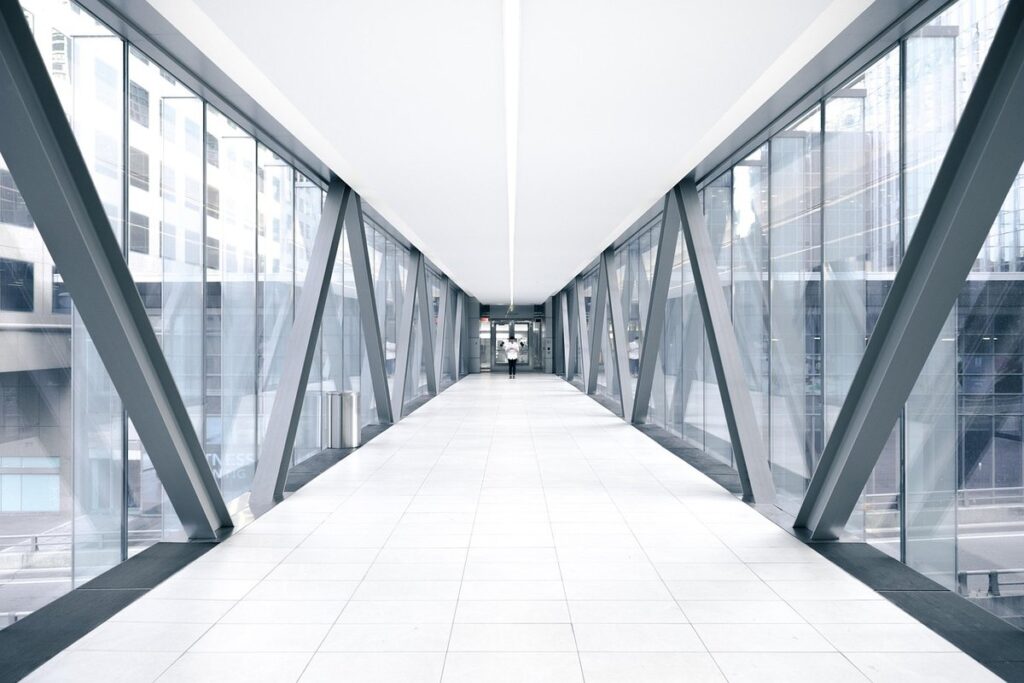
What is Two Point Perspective?
Two-point perspective is a drawing technique that helps create realistic and believable scenes, allowing you to depict buildings, landscapes, and other subjects from multiple angles. It’s a fundamental concept for artists of all skill levels.
Definition and History
Two point perspective is a drawing technique used to create a three-dimensional illusion on a two-dimensional surface by depicting receding lines and overlapping planes. It involves establishing two vanishing points on a horizon line, which serves as the basis for creating depth and distance. This method differs from one point perspective, where only one vanishing point is used, resulting in a more simplified and less nuanced representation.
The history of two point perspective dates back to the 15th century during the Italian Renaissance. Artists such as Leonardo da Vinci and Michelangelo used this technique to create convincing and realistic images. Two point perspective allows artists to depict complex architectural scenes, detailed landscapes, and even abstract compositions with greater precision and accuracy. It’s particularly useful in mediums like architecture, product design, and technical drawing, where accuracy is paramount.
When executed correctly, two point perspective can create a sense of depth and volume that engages the viewer’s eye. By establishing clear vanishing points and using overlapping planes, artists can guide the viewer’s attention through the composition, creating a more immersive experience.
Benefits and Applications
Using two point perspective in art offers several benefits, particularly its ability to create a sense of depth and distance. This technique allows artists to convey complex spatial relationships between objects and environments, making it ideal for architectural and interior design renderings. For instance, architects use two point perspective to create accurate and detailed drawings of buildings and spaces, helping clients visualize the finished product.
In visual effects for film and gaming, two point perspective is used to create immersive environments and backgrounds. Artists can accurately depict the relationship between characters and their surroundings, making the scene feel more realistic. Interior designers also employ this technique to showcase furniture and decor in a room’s context. To effectively apply two point perspective in your work, start by identifying the key elements you want to emphasize – such as a building’s facade or a character’s movement through space. Then, use vanishing points to establish a clear sense of depth and distance. By mastering this technique, artists can create more engaging and believable environments that draw the viewer in.
Understanding the Basics
Two-point perspective is a fundamental concept that can be daunting for beginners, so let’s start by breaking down its basic components and how to apply them in your art. We’ll cover the essential principles you need to get started.
Setting Up Your Perspective Grid
When setting up a basic two-point perspective grid, you need to start by choosing the correct vanishing points. These should be placed at an angle of about 30-40 degrees to each other, roughly corresponding to the angle of view you’re trying to achieve. A common mistake is placing the vanishing points too close together or too far apart; aim for a moderate distance to ensure your grid isn’t distorted.
The horizon line, which represents the eye level of the viewer, should be placed where it makes sense in relation to your subject matter. For example, if you’re drawing an indoor scene with a low ceiling, you might place the horizon line relatively high on the page. If you’re drawing an outdoor landscape, you’ll likely place it lower.
You can use software like Adobe Illustrator or Photoshop to create a perspective grid by setting up guides and snapping lines into place. You can also use physical drawing tools like a ruler or a perspective gauge to draw your grid directly onto paper. The key is to accurately replicate the way our eyes see in two-point perspective: converging parallel lines receding into the distance.
Drawing Basic Forms in Two Point Perspective
To draw basic forms like boxes, cylinders, and cones in two point perspective, follow these steps. First, establish the horizon line, which should be positioned according to your desired vanishing point. A box in 2PP can be divided into six planes: front, back, left, right, top, and bottom.
To draw a simple box, determine its height-to-width ratio. Keep this ratio consistent for all boxes within a single composition. For example, if you’re drawing a building with a flat roof, the walls should have the same width as the floor. This ensures the structure looks proportionate.
When drawing cylinders or cones, place their base on the horizon line and use reference lines to establish their height and placement in space. Be mindful of where the vanishing points intersect: this will help you accurately draw these forms. Keep your drawings proportional by using measurements and comparing them with a ruler or straightedge.
A simple example would be drawing a cylindrical column standing alone against a flat background. A common mistake is neglecting to maintain accurate proportions between the base, middle, and top sections of a cylinder.
Advanced Techniques
Now that you’ve mastered the fundamentals of two-point perspective, it’s time to take your skills to the next level and explore more complex techniques for creating convincing depth and atmosphere in your drawings. We’ll cover some advanced methods for enhancing realism.
Creating More Complex Forms
When drawing complex forms like arches, columns, and stairs using two-point perspective, it’s essential to break down each element into simpler shapes. Start by identifying the basic forms within the overall structure: for example, an arch can be broken down into a series of connected ovals or ellipses. Use overlapping lines to create depth and indicate where each form meets another. Overlapping lines can also help to suggest the complexity of the underlying structure.
Atmospheric perspective comes into play when rendering these forms. Distant elements should appear lighter and less defined, while foreground elements are more detailed and darker. This can be achieved by adjusting the values and contrast of your shapes, with the most distant elements fading into the background. Consider using atmospheric perspective to subtly convey the sense of depth in complex architectural features like staircases or columns.
For example, a column might appear as a simple cylinder at the base, with its top becoming increasingly indistinct due to the atmosphere. By applying these techniques, you can convincingly depict even the most intricate forms within your two-point perspective drawings.
Using Two Point Perspective in Different Mediums
Two point perspective can be applied to various mediums beyond traditional drawing and painting. In digital art, for instance, you’ll often work with a 2D interface where depth cues are subtly integrated into the software’s functionality. This means that instead of strictly adhering to linear perspective rules, you may use layering, scaling, and other features to create convincing depth.
In contrast, traditional mediums like painting and drawing require more deliberate attention to line quality and value to achieve a strong two point perspective effect. Watercolor or gouache can be particularly challenging due to their unpredictable nature – it’s essential to plan your composition carefully before applying paint to avoid losing control over the process.
Another key consideration when adapting two point perspective to different mediums is the interplay between media-specific techniques and traditional methods. For example, in digital art you might employ 3D modeling to create a more immersive environment, while simultaneously adhering to two point perspective principles for atmospheric perspective. By understanding these nuances and how they intersect with your chosen medium, you can achieve far more convincing results in both 2D and 3D formats.
Troubleshooting Common Issues
As you continue to refine your two-point perspective skills, it’s inevitable that you’ll encounter a few bumps along the way. This section addresses common issues artists face when mastering this technique.
Common Mistakes to Avoid
When working with two point perspective, it’s easy to make mistakes that can throw off the entire composition. One common error is placing the vanishing points too far apart, which can create a distorted or unnatural atmosphere. To avoid this, try aligning the vanishing points at least as wide as the scene you’re drawing, but no wider than your paper allows.
Another mistake is misplacing the horizon line. If it’s placed too high, buildings and objects will appear too tall and the space will feel cramped. Conversely, a low horizon can make the scene feel flat and unengaging. To troubleshoot this issue, check if your horizon line aligns with the midpoint of your vanishing points.
Remember that two point perspective relies on creating depth through converging lines, so it’s essential to pay attention to these lines’ direction and convergence. If they appear too loose or uneven, revisit your placement of the vanishing points and re-check the alignment of the horizon line.
Overcoming Frustration with Two Point Perspective
Two point perspective can be a humbling medium to work with, especially when you’re first starting out. Many artists have reported feeling frustrated by the seemingly impossible task of creating convincing depth and distance on a flat surface. But frustration is not an insurmountable obstacle – it’s actually a normal part of the learning process.
Consider the example of Renaissance masters like Leonardo da Vinci and Michelangelo, who struggled to perfect their perspective skills for years before producing iconic works that showcased their mastery. Even today, artists like Shigeru Saito, whose breathtaking watercolor illustrations have appeared in The New Yorker and other publications, admit to still working on their perspective skills.
To overcome frustration with two point perspective, try breaking down complex scenes into smaller components. Focus on drawing one plane at a time – the horizon line, for instance – before gradually adding more layers of depth. And remember that practice is key: the more you draw in two point perspective, the more intuitive it becomes.
Putting it into Practice
Now that you’ve grasped the basics of two-point perspective, let’s put your newfound skills to use by applying them to real-world projects and exercises.
Exercises for Practice and Improvement
To deepen your understanding of two-point perspective, try drawing simple compositions with a single vanishing point. Start by sketching a city street or a corridor with a clear central axis. Use a ruler to draw straight lines that converge at the vanishing point, creating the illusion of depth. Focus on accurately placing and measuring the lines to achieve a convincing sense of distance.
For more challenging exercises, create scenes with multiple planes intersecting. For example, try drawing an interior space where walls, floor, and ceiling meet at a single vanishing point. Practice varying the height and angle of your planes to observe how it affects the overall perspective.
To improve your skills, regularly practice measuring and placing lines in relation to the vanishing point. Use a grid or graph paper to help you achieve more accurate results. Experiment with different subjects, from everyday environments to fantastical settings, to apply two-point perspective principles in creative ways.
Projects and Ideas for Using Two Point Perspective
Creating realistic cityscapes is a great way to put two-point perspective into practice. Imagine drawing a bustling metropolis with towering skyscrapers and busy streets. To achieve this, start by establishing a vanishing point on the horizon line, then create lines that converge at this point. Use overlapping buildings and cars to add depth and interest.
You can also design buildings using two-point perspective. For instance, draw a single-story building with a focus on its facade. Pay attention to details such as windows, doors, and architectural features. By mastering the basics of two-point perspective, you’ll be able to create more convincing and realistic drawings.
Another idea is to recreate famous landmarks or historical buildings using two-point perspective. This will help you understand how the technique can be applied in different contexts. Take your time to observe the lines, shapes, and proportions of the building’s exterior, then translate these into a 2D representation on paper. Experiment with different views and angles to capture the essence of the structure.
Advanced Applications
As you continue to refine your two-point perspective skills, you’ll want to push the boundaries of what’s possible by applying these techniques to more complex and intriguing scenarios. This includes rendering urban landscapes, cityscapes, and iconic structures in a realistic way.
Using Two Point Perspective in Architecture and Interior Design
Two point perspective is a crucial tool for architects and interior designers to accurately convey complex spatial relationships and create immersive designs. By using software like Autodesk Revit, SketchUp, or ArchiCAD, they can manipulate 2D representations of buildings and spaces with precision, taking into account the nuances of their surroundings.
These programs enable designers to set precise vanishing points, allowing them to control the depth and scale of their renderings. This level of detail is essential for visualizing intricate details such as staircases, archways, or other features that require a high degree of spatial accuracy. Designers can also use these tools to create mockups of furniture layouts, helping clients better understand the functionality of a space.
To effectively utilize 2 point perspective in design software, it’s essential to have a solid grasp of the technique itself. By combining this knowledge with the capabilities offered by computer-aided design (CAD) programs, architects and interior designers can produce highly detailed and realistic designs that showcase their vision for a project.
Creating Cinematic Scenes with Two Point Perspective
Visual effects artists rely heavily on two point perspective to create immersive environments for film and gaming. This technique allows them to accurately depict complex spaces, from bustling city streets to sprawling landscapes. By carefully setting up vanishing points and using atmospheric perspective, artists can trick the viewer’s eye into believing they’re gazing at a fully-realized world.
Movies like Inception and The Matrix showcase exceptional use of two point perspective in their environments. The iconic “bullet time” effect in The Matrix, where characters move through a seamless urban landscape, is a testament to this technique’s power. Similarly, the dreamscapes in Inception rely heavily on 2PP to create a sense of depth and realism.
To apply this technique effectively, artists must balance precision with creative freedom. This requires a deep understanding of perspective rules, as well as an eye for composition and visual storytelling. By mastering two point perspective, artists can transport viewers into their creations, making the impossible feel all too real.
Frequently Asked Questions
What if I’m still struggling to create realistic cityscapes with two point perspective after completing the exercises in the article?
Yes, it’s normal to feel frustrated or stuck when applying complex techniques like two point perspective. Try breaking down your scene into smaller components and focus on one area at a time. Use reference images of real-world cities to help you accurately capture architectural details and depth cues.
How do I know if my two point perspective drawing is too contrived or unnatural-looking?
A natural-looking two point perspective drawing should maintain the illusion of space while avoiding visual distractions. Pay attention to the placement of lines, shapes, and textures in your composition. Ask yourself: “Would a real-world observer notice anything out of place or forced in this scene?”
Can I use two point perspective for still-life compositions, such as painting a vase on a table?
Yes, you can apply the principles of two point perspective to still-life compositions. However, keep in mind that the vanishing points and horizon line may not be as clearly defined as they would be in architectural scenes. Experiment with adjusting your perspective grid or using atmospheric perspective to create depth.
What’s the best software or tool for creating a two-point perspective grid when working digitally?
The best software or tool depends on your personal preference and skill level. Popular options include Adobe Photoshop, Illustrator, and SketchUp. Look for tutorials specific to your chosen software, as each has its unique features and workflows for setting up and editing perspective grids.
How can I adapt the techniques of two point perspective for drawing scenes with multiple levels or layers, like a skyscraper with multiple floors?
When dealing with complex scenes featuring multiple levels or layers, use overlapping lines and atmospheric perspective to create depth. Focus on accurately capturing the relationships between vertical elements, such as columns, stairs, and railings, which can help guide the viewer’s eye through the space.

