
Drawing eyes is often considered one of the most challenging aspects of portraiture, yet it’s also an essential skill for artists to master. A well-drawn eye can convey emotion and personality, making or breaking a portrait’s overall impact. When learning how to draw eyes, anatomy plays a crucial role in capturing their subtleties – from the delicate shape of the iris to the surrounding bone structure. Getting proportions right is equally important, as even slight inaccuracies can throw off the entire face. This comprehensive guide aims to cover both basic and advanced techniques for drawing realistic eye expressions, including tips on capturing subtle nuances and emotions through various line weights and shading methods. By the end of this step-by-step tutorial, you’ll be able to craft eyes that convincingly convey a wide range of emotions, elevating your portraits from mere representations to truly compelling works of art.
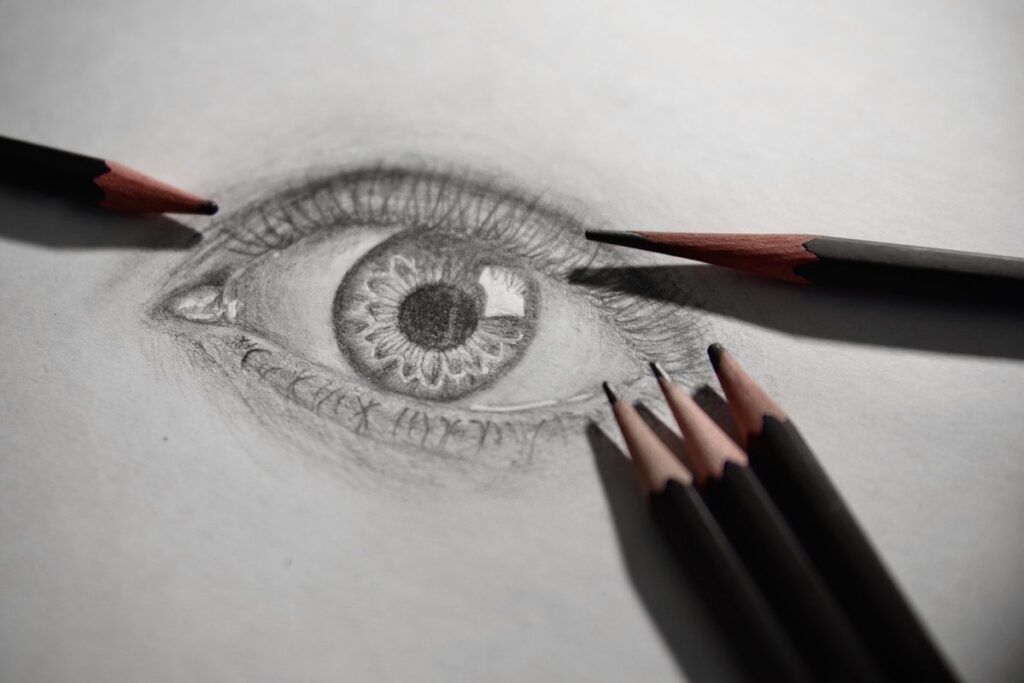
Understanding Eye Anatomy
The eyes are the windows to the soul, and understanding their intricate anatomy is essential for creating realistic and expressive portraits. Let’s break down the key components that make up a human eye.
Basic Structure of the Human Eye
The human eye is a complex and intricate organ, but understanding its basic structure can help you draw it more accurately. The iris, which surrounds the pupil, controls the amount of light entering the eye by adjusting its size. It comes in various colors due to the distribution of pigment, with some people having one dominant color and others having multiple shades.
The sclera, on the other hand, is the white part of the eye that provides protection and structure. It’s visible when you look at someone from the side or from a profile view. The cornea, which sits atop the iris, works in conjunction with the lens to focus light onto the retina. This transparent layer is crucial for clear vision.
The retina itself contains photoreceptor cells called rods and cones that convert light into electrical signals, which are then transmitted to the brain. Understanding how these parts interact can help you draw a more realistic eye. For example, when drawing an iris, remember that it’s usually thicker at the center and thinner towards the edges. Similarly, the sclera should be slightly rounded to resemble the natural curve of the human eye.
Importance of Proportions in Drawing Eyes
Accurate proportions are crucial when drawing eyes, as they greatly impact the overall likeness and expression of a face. A well-proportioned eye is essential for creating a believable character or portrait. To achieve proper proportions, it’s essential to measure the distance between the inner corners of each eye, which should be roughly one-third of the way down from the top of the head.
The width of the eyes in relation to the overall face is also significant. Typically, the widest part of the eye should be slightly narrower than the widest part of the nose. Measuring this can be achieved by using a ruler or drawing tool to gauge the proportions on your reference image. Be cautious not to confuse the width of the iris with the entire eye; the iris itself should only occupy about two-thirds of the eye’s total diameter.
Inadequate attention to proportion can result in unconvincing characters or portraits, regardless of skill level. Even a small discrepancy in measurement can alter the overall appearance and expression of a face.
Basic Shapes and Forms
When drawing eyes, understanding basic shapes is crucial for creating realistic proportions. Let’s start by breaking down the fundamental forms that make up an eye.
Drawing Circles for the Iris and Pupil
Drawing a perfect circle for the iris and pupil can be challenging, but it’s crucial to get it right. A smooth curve is essential for creating a believable eye shape. To draw circles, start by placing the tip of your pencil on the paper where you want the circle to begin. Keeping the pencil still, gently rotate your hand in a circular motion while maintaining gentle pressure. This will help you create a smooth, even curve.
Another way to achieve perfect circles is to use a compass or a stenciled circle guide. These tools allow for precise control and ensure that your circles are consistently sized and shaped. For finer details, try using a small round brush with a steady hand. Practice drawing circles without looking at the paper – this will help you develop muscle memory and improve your skills.
When drawing the iris and pupil, remember to vary the size of the circles to create depth and dimension. The pupil should be slightly smaller than the iris, and both should be proportional to the rest of the eye shape. Pay attention to subtle gradations in curve smoothness to convey the nuances of human anatomy.
Creating the Eye Socket with Rectangles and Triangles
To create the eye socket using basic shapes, start by drawing a rectangle for the outer rim. The top edge of the rectangle should be slightly curved to mimic the natural shape of an eyebrow bone. This will help you position the eye correctly on the face.
Next, draw a smaller triangle inside the rectangle to represent the eye socket itself. The base of this triangle should align with the center of the rectangle’s lower edge, and its apex should reach just above the midpoint of the rectangle’s upper edge. Pay attention to the proportions: the triangle should be about one-third to one-quarter the height of the rectangle.
By using these basic shapes, you’ll get a good foundation for the eye socket. Remember that the key is accuracy in placement and proportion. Practice drawing eyes on different faces or portraits to see how this shape translates into realistic representations.
Drawing the Eyelids and Eyelashes
Now that we’ve mastered the basics of eye shapes, let’s move on to drawing those delicate eyelids and lashes that frame our eyes. This crucial detail will bring depth and realism to your drawings.
Upper and Lower Eyelid Shapes and Placement
The upper and lower eyelids are crucial components of a well-proportioned eye drawing. There are two primary types of eyelid curves: rounded and angular. Rounded lids have a smooth, curved shape that meets the lash line at an angle. Angular lids, on the other hand, have a more defined edge and meet the lash line at a sharper angle.
To accurately place these lids, consider the bone structure beneath them. The upper lid typically follows the curve of the orbital ridge, while the lower lid usually sits below the cheekbone. When drawing, imagine a smooth line that connects the inner corner of the eye to the outer corner, curving slightly upwards towards the lash line.
As you place the lids, pay attention to their length and position relative to the iris. Typically, the upper lid is shorter than the lower lid, but this can vary depending on the individual’s facial structure. In general, a longer lower lid creates a more dramatic effect, while a shorter one can make the eye appear wider-set.
Adding Eyelashes for Texture and Depth
When drawing eyelashes, consider adding texture and depth by varying their thickness and length. Some eyes have sparse lashes along the top lash line, while others have a full set of thick lashes. You can also add individual lashes to give the eye more dimension. To create different styles, try using short, fine lines for delicate lashes or thicker, more spaced-out strokes for fuller ones.
You can also experiment with layering multiple lashes on top of each other, gradating from light to dark at the outer corner of the eye. This creates a sense of depth and adds visual interest to the drawing. When adding eyelashes, remember that their shape and thickness should complement the surrounding features – if you’re drawing a strong, angular eye, keep the lashes simple and understated.
For more dramatic effect, try using hatching or cross-hatching techniques to suggest the texture of individual lashes. This can be especially effective when combined with subtle shading in the eyelid area.
Eye Expression and Emotion
Eyes are more than just windows to the soul, they convey emotions and attitudes that can make or break a drawing. Let’s learn how to capture the subtleties of human expression through our eye drawings.
Capturing the Look: Understanding Facial Muscles and Expressions
Facial muscles play a crucial role in conveying emotions through eye expressions. The zygomaticus major and orbicularis oculi are two primary muscles involved in shaping facial movements around the eyes. The zygomaticus major, responsible for smiling, can be seen pulling the outer corner of the eye upwards when engaged. In contrast, the orbicularis oculi controls eyelid movement, enabling a range of expressions from subtle blinking to intense staring.
When drawing eyes, capturing these subtleties is essential for creating realistic and emotive portraits. To achieve this, observe how facial muscles interact with the surrounding skin and underlying bone structure. Note that even slight variations in muscle engagement can significantly alter the appearance of the eye. For example, a gentle smile will soften the outer corner of the eye, while intense concentration may cause the eyebrows to furrow.
To accurately depict these nuances, study reference images of people expressing different emotions. Pay particular attention to how the eyelids and surrounding skin respond to muscle activity. By understanding the interconnectedness of facial muscles and their effect on eye expressions, you’ll be better equipped to convey a wide range of emotions in your drawings.
Adding Shading and Depth to Eyes for Realism
Shading and depth are crucial elements in creating realistic eyes. Without them, the eyes can appear flat and unengaging. To add dimension to the eyes, try using hatching techniques. Hatching involves drawing parallel lines that follow the contours of the eye shape. The direction and density of these lines can be adjusted to create varying degrees of shading.
For instance, to depict a subtle highlight on the upper lid, use short, closely spaced lines in a gentle slope. Conversely, for deeper shadows, employ longer lines with greater spacing. Cross-hatching can also be used to add depth by layering hatching strokes at different angles. This technique creates a textured appearance that mimics the way light interacts with the delicate skin around the eyes.
When cross-hatching, begin with coarse strokes and gradually transition to finer ones as you build up layers of shading. Be mindful not to overdo it – too much cross-hatching can lead to an overly dark or muddy appearance.
Advanced Eye Drawing Techniques
Now that you’ve mastered the basics, it’s time to take your eye-drawing skills to the next level by learning how to create realistic iris textures and shading. You’ll discover expert techniques for adding depth and dimension to your eye drawings.
Creating Different Eye Types: Monolids, Epicanthic Fold, etc.
To create realistic monolids, focus on shaping a single crease where the eyelid meets the eye socket. This means erasing or softening the double fold found in many Western eyes. A gentle S-curve can help define the shape of the lid. Practice drawing different monolid shapes to get a feel for how they change with facial expressions.
Epicanthic folds, on the other hand, are created by applying subtle pressure to the eyelid as it meets the eye socket. This fold gives the illusion of an extra layer of skin at the inner corner of the eye. Start by drawing a soft curve along the edge of the lid, then blend it gently into the surrounding area.
Consider reference images from different ethnicities when studying these features. Pay attention to how they interact with other facial elements, like eyebrows and nose shape. Note that monolids and epicanthic folds can be subtle, so study them closely in real-life portraits or drawings.
Refining the Eye with Smaller Details: Pupil Size, Iris Patterns, etc.
The size and shape of the pupil can greatly vary from one person to another. Observe how some people have larger pupils than others, while a few may even have vertically slit pupils. These variations are not just a matter of aesthetics; they also hold significance in terms of eye function. A larger pupil allows more light to enter the eye, making it useful for low-light conditions. On the other hand, a smaller pupil reduces the amount of scattered light that enters the eye.
Iris patterns, too, play a crucial role in what makes eyes unique. The iris is made up of two layers: the stroma and the epithelium. The arrangement of pigment in these layers creates distinctive patterns on the surface of the iris. Some people have flecks or patches of color scattered across their irises, while others may have a ring around the pupil or even a complete sector missing. When drawing eyes, pay attention to how these patterns can subtly alter the eye’s appearance and create depth. Study real-life examples to develop your skills in rendering diverse iris patterns, and remember that it’s not just about adding color – consider the subtle shading and texture of the iris itself.
Troubleshooting Common Eye Drawing Issues
We’ve all been there: staring at your paper, wondering why those eyes just don’t quite look right. This is where common problems come in to get you back on track.
Overly Large or Small Eyes
When drawing eyes, it’s common for beginners to struggle with getting their proportions right. Overly large or small eyes can completely throw off the balance of a face. To fix this issue, start by checking the overall size of your head and facial features. If you’re using reference images, look at how the eyes relate to the surrounding features. A good rule of thumb is that the eyes should be roughly one-quarter to one-third of the way down from the top of the head.
If your eyes are too large, try reducing their height by a small amount and focusing on keeping their proportions consistent with each other. Conversely, if your eyes are too small, you can increase their size while maintaining the same proportion between them. Remember that subtlety is key when it comes to drawing realistic eyes – too much change can make them look unnatural.
When adjusting the size of your eyes, pay attention to how they interact with the surrounding features. For example, if you’re making your eyes larger, consider scaling down the nose and mouth slightly to maintain balance.
Ensuring Proportion and Balance in the Face
When drawing eyes, achieving balance and proportion is crucial for creating a believable face. The first step in ensuring proportion is to consider the relationship between facial features, particularly the eyes, nose, and mouth. A common issue is when one feature dominates the others, throwing off the entire balance of the face.
To fix unbalanced features, start by analyzing your reference image or model. Notice the proportions of the eye sockets, eyebrow arches, and surrounding areas. Pay attention to how these elements interact with each other. For example, if the eyebrows are overly prominent, consider softening their shape or reducing their width.
In particular, pay attention to the space between the eyes (the interocular distance) and the placement of the nose in relation to the eyes. A general rule is that the outer corner of one eye should align with the inner corner of the opposite eye, creating a harmonious triangle shape. If your drawing suffers from an unbalanced nose, try adjusting its position slightly upwards or downwards to create a more balanced look.
Frequently Asked Questions
Can I use this guide to draw non-human eyes, like animal eyes?
Yes. While the guide focuses on human eye anatomy and proportions, you can adapt these principles to draw eyes from other species. Pay attention to the unique features of each animal’s eyes, such as size, shape, and structure.
How long does it take to master drawing realistic eyes with this guide?
Mastering the art of drawing realistic eyes takes time and practice. With consistent effort and dedication, you can achieve proficiency in 1-3 months, depending on your prior artistic experience and frequency of practice. Start by breaking down the lessons into smaller chunks and focusing on one aspect at a time.
What if I’m not good at shading and hatching? Can I still draw realistic eyes?
Yes. Shading and hatching are advanced techniques that can be learned separately. You can begin by practicing basic shading with simple shapes and gradually move on to more complex subjects, including the eyes. The key is to focus on building your skills gradually.
How do I ensure my drawings aren’t too perfect or unnatural-looking?
Aim for balance between realism and natural imperfections. Study photographs of real people’s faces and observe the subtleties in their eye expressions. Practice drawing from life and using reference images to capture the unique characteristics of each subject.
Can I use digital tools to draw eyes, or is this guide only suitable for traditional media?
The principles outlined in this guide can be applied to both traditional and digital mediums. You can adapt the techniques for drawing with digital tools like Procreate, Adobe Photoshop, or Illustrator by using a variety of brushes and layering methods to achieve realistic textures and shading effects.

